India carries 43.3% of Asia’s chronic respiratory disease burden, according to a 2026 analysis published in The Lancet Respiratory Medicine. The scale of this burden makes reliable and practical lung function assessment increasingly important across Indian respiratory clinics.
Spirometry has long been a key part of this assessment, but it does not work equally well for every patient. The test depends on a patient’s ability to understand the instructions and produce a sustained, forceful breath. This can become difficult for young children, older adults, severely breathless patients, and others who struggle with forced breathing.
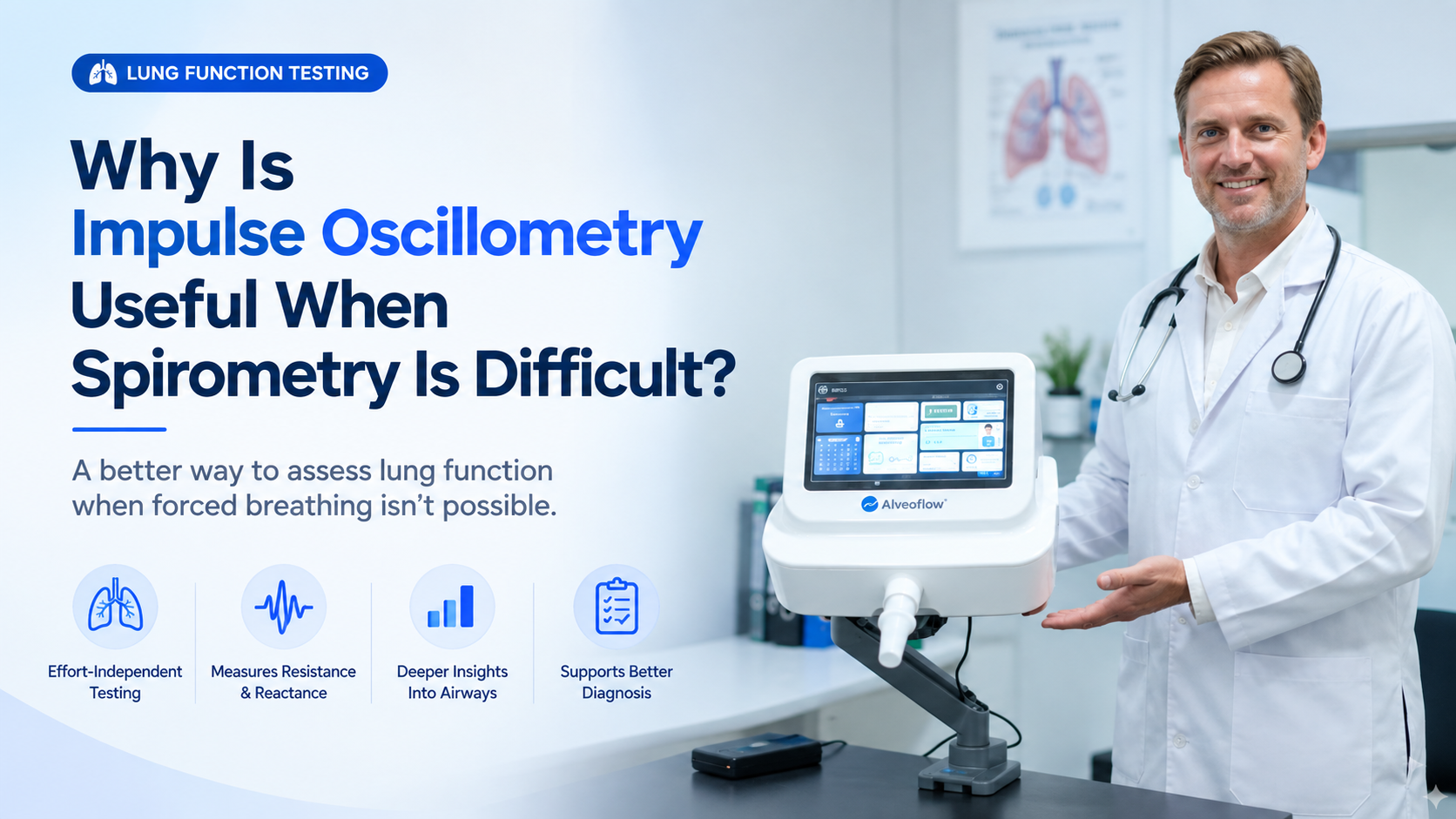
This is why more Indian clinics are exploring FOT Forced Oscillation machines as a complementary approach to respiratory testing. But what is driving this shift, and why is effort-independent testing becoming relevant to modern respiratory clinics? This article answers exactly that!
What Exactly Is Driving the Shift Toward Effort-Independent FOT?
Clinics are considering FOT because it can assess respiratory function without asking patients to perform repeated, forceful breathing manoeuvres. This is especially important when a patient’s effort, age, physical limitations, or difficulty following instructions make conventional forced testing challenging.
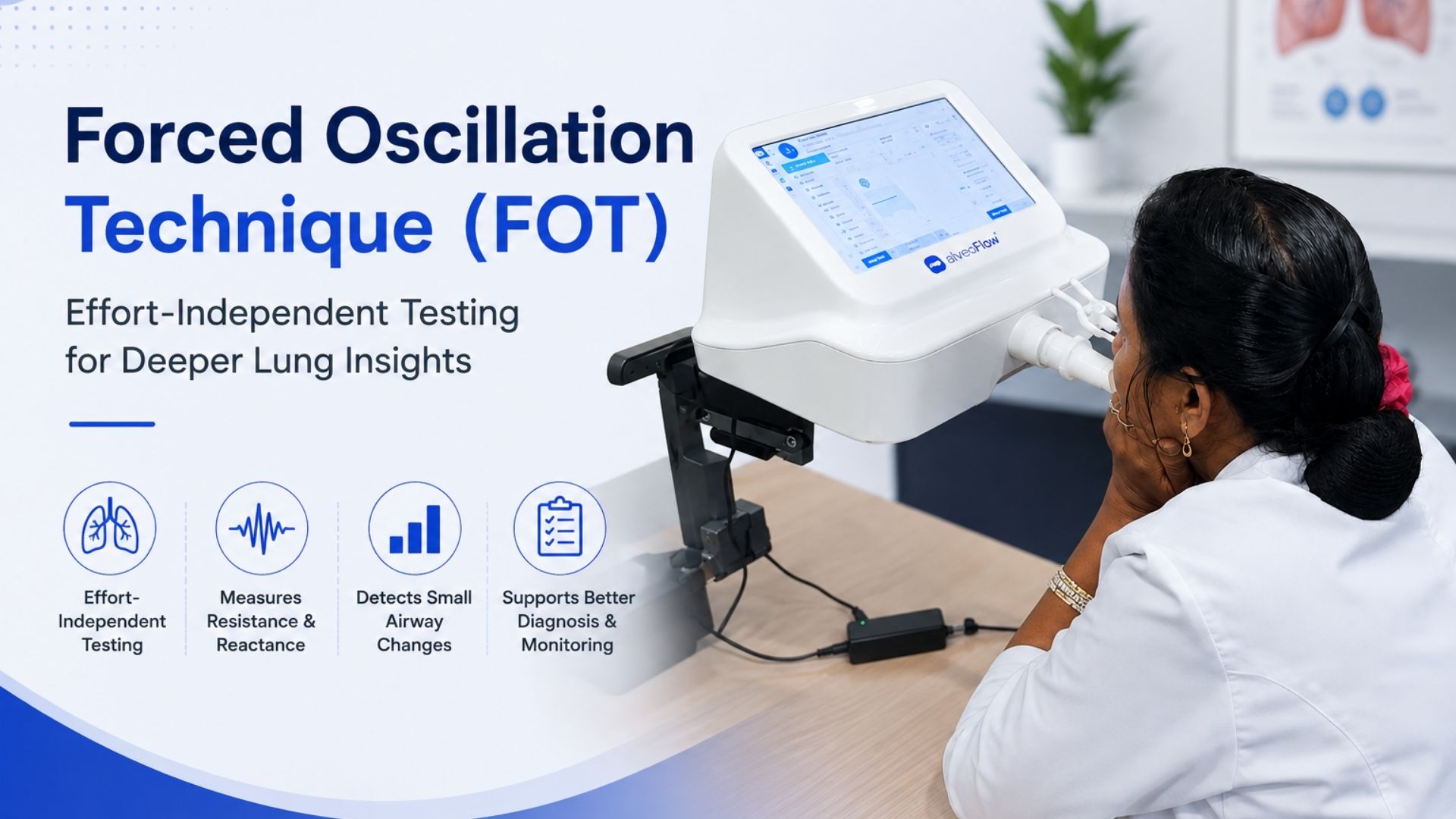
A forced oscillation machine in India allows patients to breathe quietly while the device measures respiratory mechanics. This makes testing more feasible for patients who may struggle with forced spirometry. Moreover, it gives clinicians access to physiological information that complements conventional pulmonary function testing.
1. The Coaching Burden Can Make Forced Testing Difficult
A good spirometry reading depends on how well the patient can follow the breathing instructions. The patient needs to take a deep breath, place their lips firmly around the mouthpiece, and then blow out as hard and as long as instructed.
This can be an easy process for most patients. However, some patients can experience problems. They may need to repeat the process quite a few times and still not get accurate results.
That’s exactly where the FOT Forced Oscillation machine in India makes a difference. The tests done through FOT take a different approach. The patient needs to breathe quietly into FOT while the device measures the respiratory response to small pressure oscillations. This reduces the dependence on repeated coaching and maximal expiratory effort.
2. Some Patients Simply Cannot Perform the Test Properly
Some patients may still struggle to perform spirometry correctly even with proper guidance. They may feel tired, have difficulty coordinating their breathing, or find it hard to blow out with enough force.
Older adults can be particularly affected by these challenges. Fatigue, physical limitations, or difficulty following the breathing instructions can make repeated attempts harder and may prevent them from producing a reliable result.
Repeating the test several times does not always solve this problem. In fact, it can leave the patient tired while still failing to provide a useful result. FOT, on the other hand, does not require the patient to produce the same forceful breath. The patient can breathe quietly while the device measures how the respiratory system responds to small pressure oscillations.
This makes an FOT Forced Oscillation machine in India a useful option when getting a reliable forced breathing test becomes difficult.
3. Children and Older Adults Can Benefit From Lower Effort Testing
Spirometry can be especially difficult for children. A young child may understand that they need to blow into the device but still struggle to follow the instructions and repeat the breathing process correctly. But things can be different with a Forced Oscillation Machine in India.
The child can breathe normally while the device measures respiratory mechanics. This reduces the need for the child to understand and reproduce a forceful breathing process. This can make objective lung function testing more feasible for children with asthma, recurrent wheezing, or other respiratory concerns.
Even research shows that FOT can be successfully performed in more than 80% of children around four years of age, with feasibility approaching 100% in children over six. This is important because younger patients may not always be able to produce reliable spirometry results.
4. The Testing Process Also Raises Infection-Control Considerations
Respiratory testing also needs to be considered from an infection-control perspective. Forced breathing can release more respiratory particles into the surrounding environment than normal quiet breathing, which makes appropriate precautions important during pulmonary function testing.
This became a much bigger concern during the COVID-19 pandemic. Respiratory clinics had to pay closer attention to ventilation, protective equipment, equipment cleaning, and the time between patients. The ERS also noted that forced respiratory activities can produce considerably more particles than quiet breathing.
FOT avoids the need for these repeated forceful breathing manoeuvres. The patient simply breathes normally into the device while small pressure oscillations are introduced into the airways and the respiratory response is measured. This means the test does not depend on the same repeated forceful expirations used during spirometry.
Use of a Forced Oscillation Machine in India does not remove the need for proper cleaning, ventilation, or other infection-control measures. However, the use of normal breathing rather than repeated forceful blows can still be an important consideration when clinics evaluate their respiratory testing process.
How Does FOT Go Beyond Conventional Lung Function Testing?
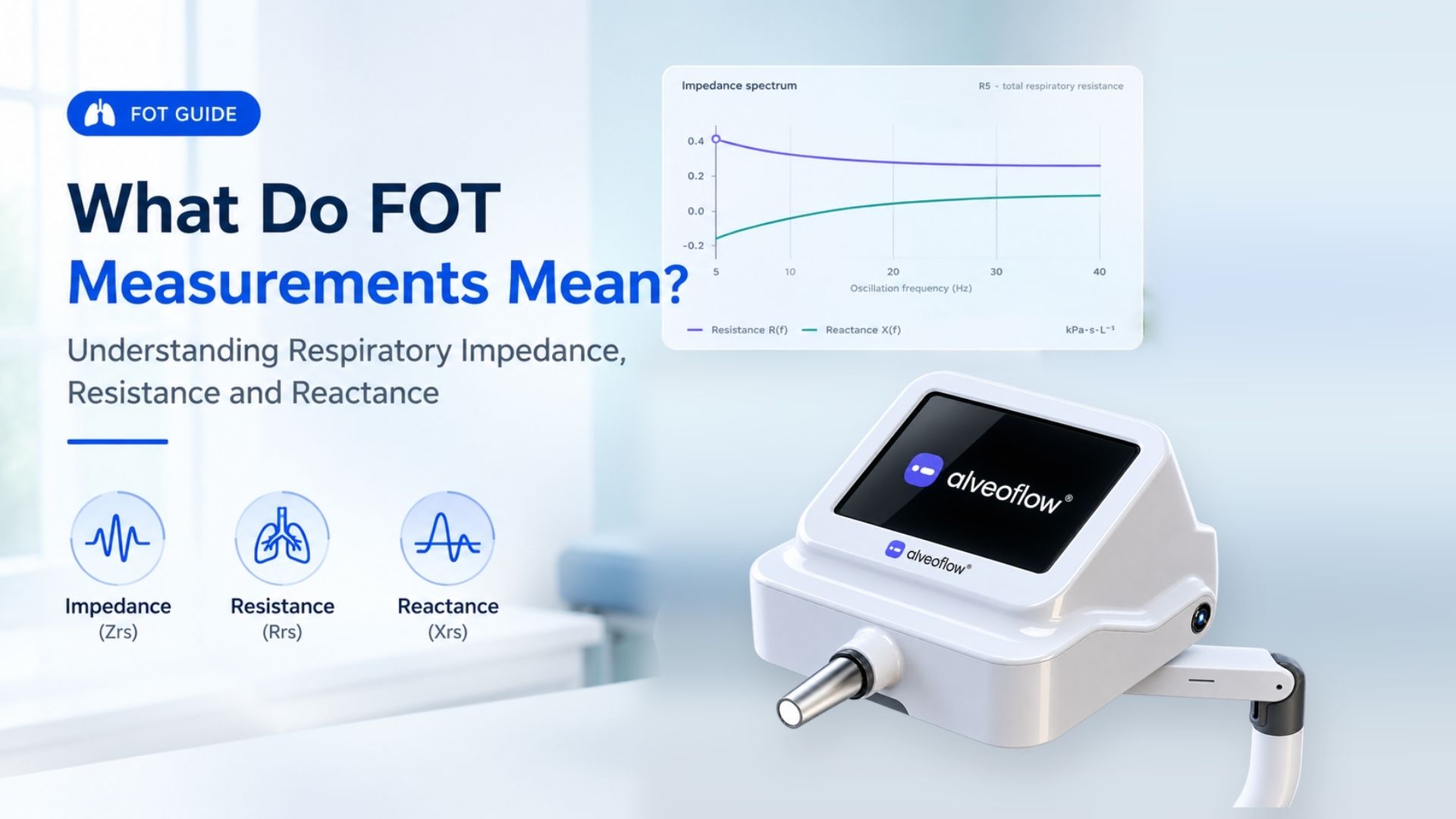
FOT goes beyond conventional testing by giving clinicians information about respiratory resistance and reactance, rather than only measuring airflow and lung volumes. These measurements provide another way to understand how different parts of the respiratory system are responding during breathing.
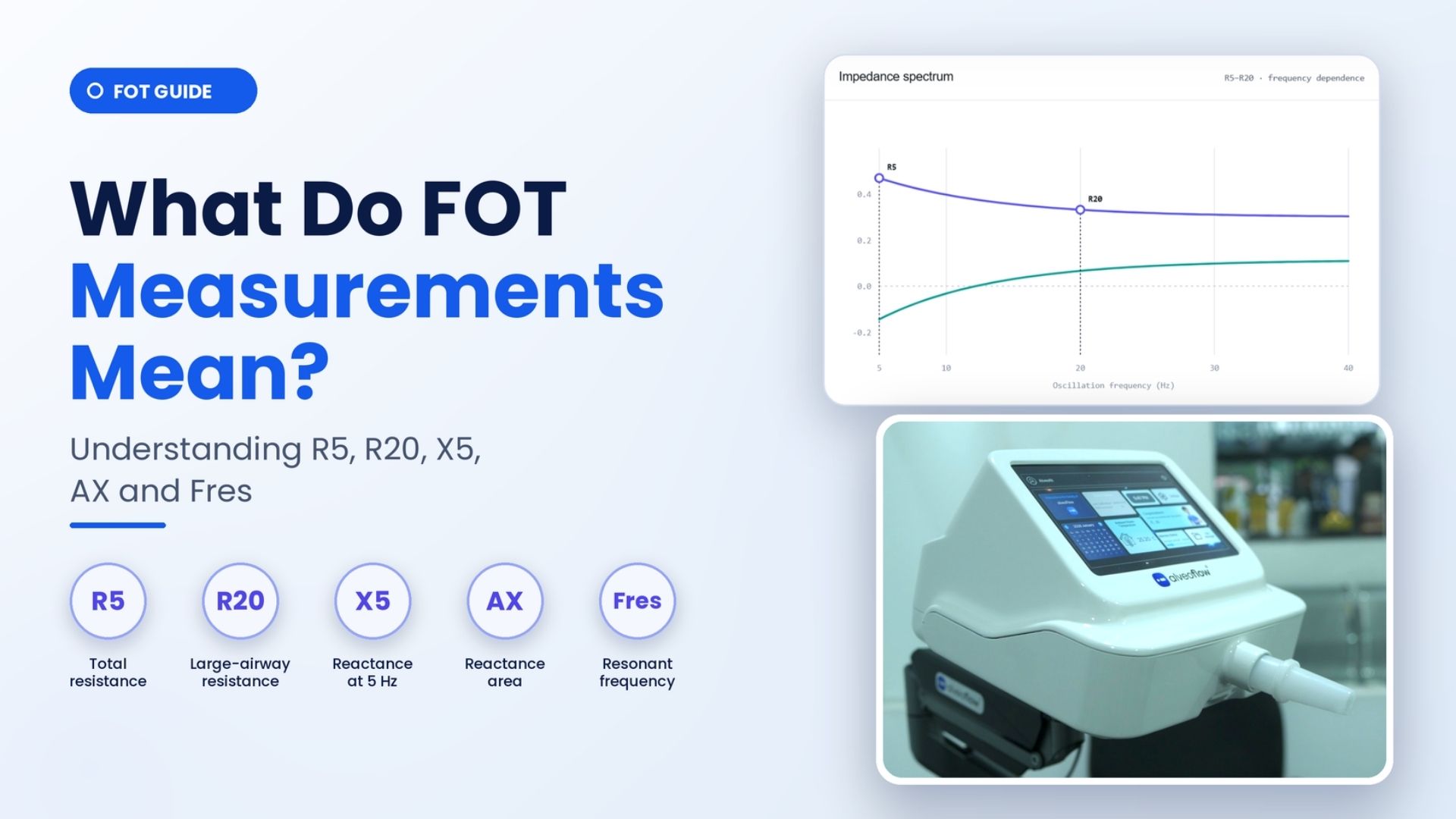
The key FOT parameters help explain where this additional information comes from.
| Parameter | What It Measures | What It May Tell the Clinician |
| R5 | Resistance at 5 Hz | Provides information about overall respiratory resistance, including central and peripheral airway contributions |
| R20 | Resistance at 20 Hz | Reflects resistance that is more strongly influenced by the central airways |
| R5–R20 | Difference between R5 and R20 | An increased difference may suggest greater peripheral airway involvement |
| X5 | Reactance at 5 Hz | Provides information about the elastic and inertive properties of the respiratory system |
| AX | Area of reactance | Summarises abnormal low-frequency reactance and may provide additional information about peripheral airway changes |
| Fres | Resonant frequency | Identifies the frequency at which respiratory reactance reaches zero and provides additional information about respiratory mechanics |
These measurements give FOT a different clinical perspective from conventional spirometry. Clinicians are not just learning how much air moves and how quickly it moves using the FOT Forced Oscillation Machine in India. Instead, it also helps them examine how the respiratory system resists and responds to oscillatory signals.
FOT vs Spirometry: Why One Does Not Have to Replace the Other
FOT does not need to replace spirometry because the two tests provide different types of respiratory information. Spirometry measures airflow and lung volumes during forced breathing, while FOT evaluates respiratory resistance, reactance, and impedance.
This table helps explain the difference between a spirometer and an FOT device:
| Aspect | Spirometry | FOT |
| Breathing approach | Forced breathing manoeuvres | Normal breathing |
| Patient effort | Requires active and sustained effort | Requires much less effort |
| Primary measurements | Airflow and lung volumes | Resistance, reactance and impedance |
| Common parameters | FEV1, FVC, FEV1/FVC | R5, R20, R5–R20, X5, AX, Fres |
| Patient coaching | Often requires detailed instruction and repeated attempts | Generally requires less coaching |
| Respiratory information | Shows how much air moves and how quickly | Shows how the respiratory system responds to oscillatory signals |
| Clinical role | Core pulmonary function test | Complementary respiratory assessment |
Can FOT Replace Spirometry?
FOT cannot completely replace spirometry because it does not provide the same airflow and volume measurements. Spirometry remains important when clinicians need parameters such as FEV1, FVC, and FEV1/FVC.
FOT adds a different set of measurements to the test. This makes it particularly useful when clinicians need additional information or when forced testing becomes difficult.
Is FOT Better Than Spirometry?
Neither test is universally better, as each one answers different clinical questions.
Spirometry is valuable when forced airflow and volume measurements are required. FOT becomes valuable when clinicians need information about respiratory resistance and reactance or when a patient struggles with forced breathing. You shouldn’t be dwelling on which test is better. Instead, the question you should be asking is “which test provides you with the information needed for the patient”.
Can Clinics Use Both FOT and Spirometry?
Yes, FOT and spirometry can be used together as complementary pulmonary function tests. Spirometry can provide the conventional airflow and volume measurements, while FOT can add information about respiratory resistance, reactance, and impedance.
This allows clinicians to choose the appropriate test based on the patient and the clinical question rather than treating the two technologies as competing options.
Conclusion
The real shift is not from spirometry to FOT. It is toward giving clinicians more flexible ways to assess respiratory function based on the patient and the clinical question.
That matters because no single respiratory test can provide every type of information a clinician may need. Spirometry remains important for measuring airflow and lung volumes, while FOT adds information about respiratory resistance and reactance. Together, they can help clinicians look at lung function from different perspectives.
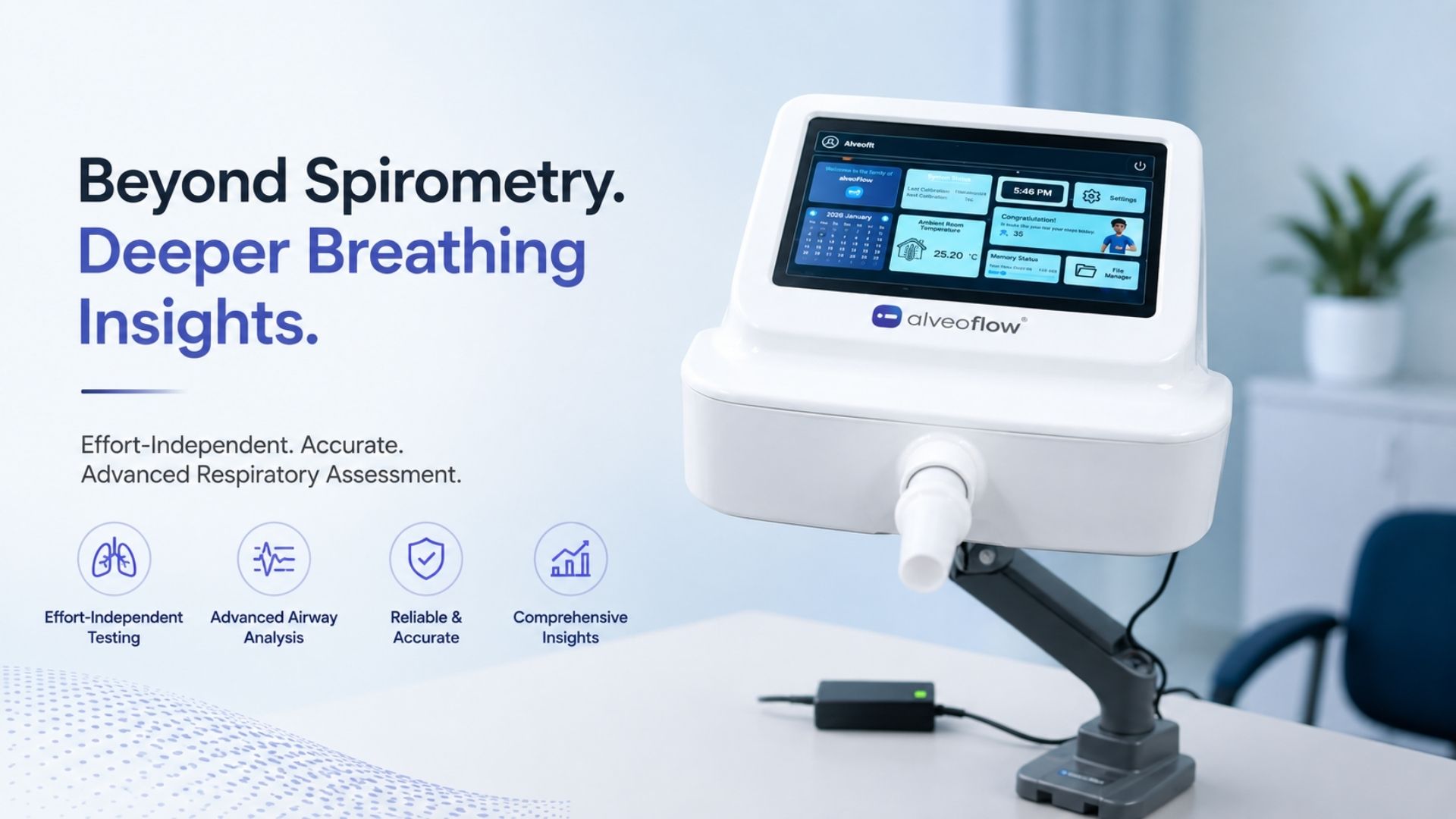
This is where alveoFlow fits into the picture. The platform brings effort-independent oscillometry into clinical settings, allowing clinicians to assess respiratory mechanics and review resistance and reactance measurements during normal breathing.
At alveofit, we also offer digital spirometers, so clinics do not have to choose between the two technologies. Instead, they can use each where it provides the most relevant information and build a more flexible respiratory testing setup.
Are you exploring an FOT Forced Oscillation machine in India? alveoFlow® can help bring this approach into your clinical workflow while complementing the spirometry solutions you may already use.
FAQs
What is the difference between FOT and spirometry?
Spirometry measures airflow and lung volumes during forced breathing, while FOT measures respiratory resistance, reactance and impedance during normal breathing.
Which patients may benefit from FOT testing?
FOT may be useful for young children, older adults, and patients who struggle with the effort or coordination required for forced breathing tests.
What do R5, R20, R5–R20, X5 and AX mean in FOT?
R5 and R20 describe respiratory resistance at different frequencies, while R5–R20 can provide information about peripheral airway involvement. X5 and AX describe aspects of respiratory reactance and can provide additional information about respiratory mechanics.
How does an FOT machine measure lung function during normal breathing?
An FOT machine introduces small pressure oscillations into the respiratory system while the patient breathes normally. It measures the resulting respiratory response to calculate impedance, including resistance and reactance.
What respiratory information can FOT provide that spirometry does not?
FOT provides information about respiratory resistance and reactance that is not captured through conventional airflow and volume measurements alone. This can give clinicians another perspective on respiratory mechanics and help identify patterns that may require further assessment.