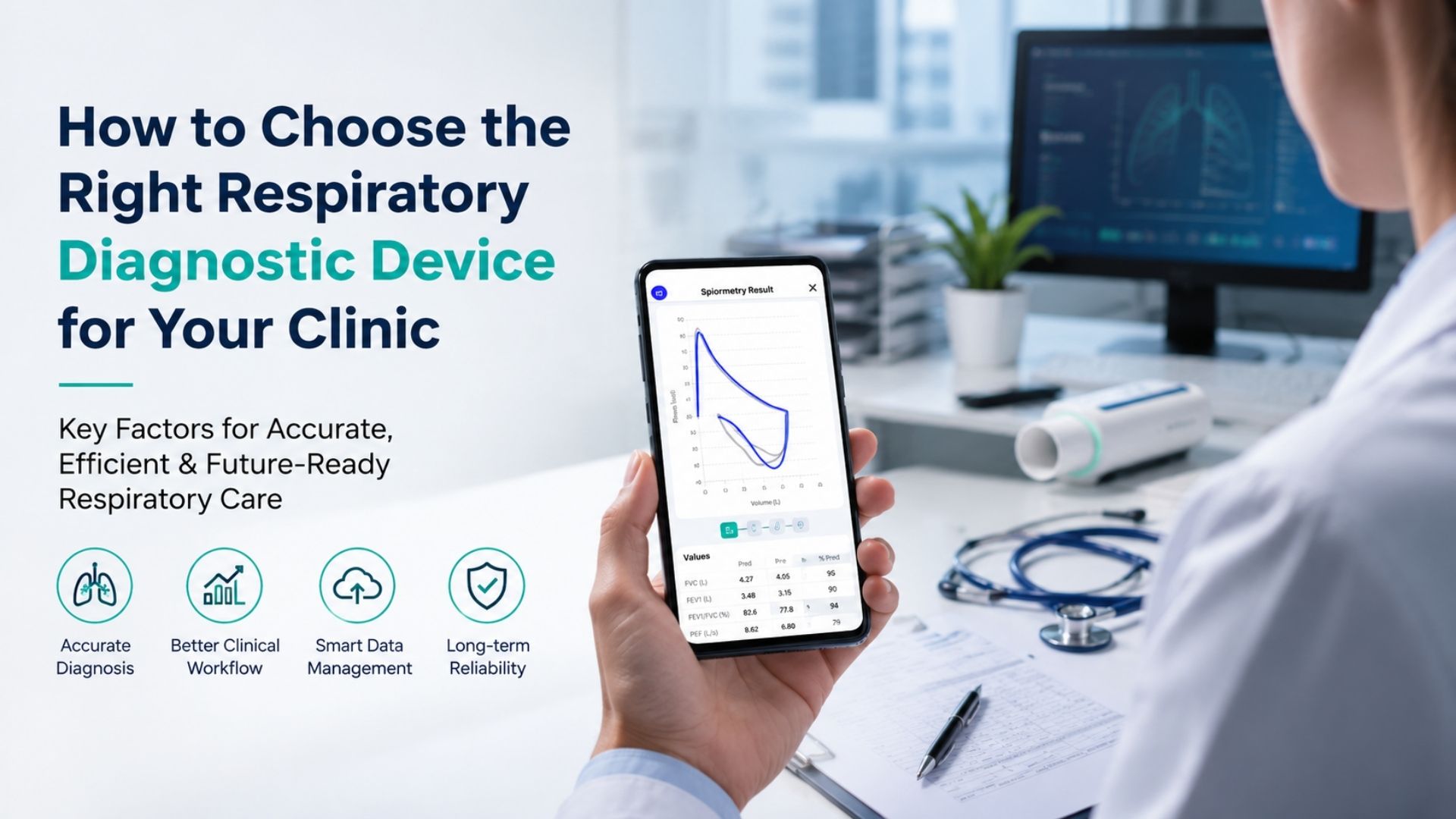
Expanding your clinic's respiratory diagnostic capabilities is an important investment, but choosing the right device isn't always easy.
Are you exploring a respiratory diagnostic device for your clinic? It's easy to compare features, specifications, or prices and assume you've found the right solution. However, many clinicians overlook equally important factors such as clinical workflow, long-term scalability, ease of use, and data management. These oversights can lead to underutilised equipment, operational inefficiencies, and additional costs down the road.
That's exactly where this guide can help. Here we discuss key considerations that matter most, helping you choose a solution that supports your patients, your team, and your clinic's long-term goals.
1. Start By Understanding What Your Clinic Actually Needs
Choosing the right patient lung monitoring system does not begin with comparing brands or exploring technical specifications. It begins with understanding your own clinical requirements.
Every clinic serves a different patient population, follows a different workflow, and has different long-term goals. Selecting a device without considering these factors can lead to unnecessary features, operational challenges, or equipment that no longer meets your needs as your practice evolves.
So, don’t just evaluate individual devices. Instead, take time to assess how respiratory testing fits into your practice today and how you expect those requirements to change in the future. The clearer you are about your clinical needs, the easier it becomes to identify a solution that supports both high-quality patient care and efficient day-to-day operations.
-
Evaluate Your Patient Population
The patients you see most often should influence the type of respiratory diagnostic tool you choose. This is important because different patient groups and testing goals require different capabilities. Hence, understanding your clinical needs helps you make a more practical investment.
Start by asking questions such as:
- Do you primarily manage patients with asthma, COPD, or other chronic respiratory conditions?
- Do you frequently evaluate children, older adults, or individuals with occupational lung diseases?
- Are respiratory assessments mainly performed for diagnosis, long-term monitoring, preventive health programmes, or pre-operative evaluations?
Your answers will help you identify the capabilities your clinic truly needs and choose a pulmonary function test device that supports your day-to-day clinical practice.
-
Estimate Patient Volume and Future Growth
Your current patient volume is important, but it shouldn't be the only factor influencing your decision. It is also important to choose a respiratory diagnostic device for clinics that can support future demand. Doing so helps avoid premature upgrades as your clinic expands.
Ask yourself questions such as:
- How many respiratory assessments does your clinic perform each week or month?
- Do you expect patient volumes or referrals to increase over the next few years?
- Are you planning to introduce new respiratory services or expand into preventive screening programmes?
Your answers will help you choose a pulmonary diagnostic device that supports higher patient throughput. It also helps improve operational efficiency and continues meeting your needs as your practice grows.
2. Prioritize Clinical Accuracy Over Long Feature Lists
Modern lung function testing devices offer a wide range of features, from cloud connectivity to automated reporting. While these capabilities can improve efficiency, they should never take priority over clinical accuracy. After all, every diagnosis, treatment decision, and follow-up plan depends on the reliability of the test results.
So, don't just ask which respiratory diagnostic device for clinics has the most features. Instead, focus on whether it consistently delivers accurate and dependable measurements. The following considerations can help you assess its clinical performance.
-
Look for ATS/ERS Compliance and Reliable Measurements
One of the easiest ways to evaluate a device's clinical reliability is to check whether it complies with internationally recognised ATS/ERS recommendations for pulmonary function testing. These standards are designed to promote accurate, repeatable, and high-quality measurements. So, when evaluating a pulmonary diagnostic device, check if it:
- Complies with the latest ATS/ERS recommendations
- Supports consistent and repeatable measurements
- Includes calibration and quality control features to maintain testing accuracy
These capabilities help minimise variations between tests and give clinicians greater confidence when interpreting lung function results.
-
Ask Whether the Device Produces Reliable Results Every Time
A device should not only perform well under ideal conditions but also deliver consistent results during everyday clinical use. This is particularly important in busy practices where different healthcare professionals may be performing respiratory assessments.
So always check the following when evaluating a respiratory diagnostic device for clinics:
- Does it deliver consistent and repeatable results across multiple tests?
- Can it identify unacceptable or poor-quality manoeuvres?
- Would it minimise unnecessary repeat testing?
- Does it maintain reliable performance regardless of the operator?
These capabilities help improve diagnostic confidence, reduce testing delays, and ensure more reliable respiratory assessments.
3. Choose a Device That Fits Your Daily Clinical Workflow
A patient lung monitoring system may offer excellent clinical performance, but it should also fit seamlessly into your everyday workflow. It can, in fact, quickly become an underused investment if it is difficult to operate, requires extensive training, or slows patient appointments.
So, don't evaluate a device based only on its technical capabilities. Instead, assess how well it supports your staff, patients, and daily operations. The following considerations can help you determine whether a digital respiratory diagnostic device is the right fit for your clinic.
-
Will Staff Be Able to Use It Confidently?
The easier a device is to use, the more efficiently your team can perform respiratory assessments while maintaining consistent testing quality. So, always check if the chosen device:
- Has an intuitive and easy-to-use interface.
- Provides guided testing workflows.
- Generates reports quickly and clearly.
- Reduces the learning curve for healthcare professionals.
These capabilities help improve staff confidence, reduce training time, and promote consistent testing across different operators.
-
Will It Improve Workflow Without Compromising Quality?
An efficient workflow is not about completing tests faster. It is about delivering accurate results while making the best use of your clinic's time and resources. This is why it's best to check if your chosen pulmonary diagnostic device:
- Minimises unnecessary repeat testing.
- Includes automated quality checks.
- Simplifies report generation.
- Helps reduce delays between patient assessments.
A digital respiratory diagnostic device with these features improves patient throughput while supporting operational efficiency and high-quality respiratory care.
4. Consider How the Device Supports Long-Term Patient Care
A single test rarely provides the complete picture for many respiratory conditions. Clinicians often need to compare multiple assessments over time to monitor disease progression, evaluate treatment effectiveness, and make informed clinical decisions.
So, don't choose a patient lung monitoring system that simply generates test results. Instead, look for one that supports long-term patient monitoring and makes follow-up care more effective.
-
Can It Store, Track, and Compare Patient Progress?
A modern lung function testing device should make it easy to review previous assessments and identify changes in a patient's respiratory health over time. So, always check if it:
- Stores patient records securely for future reference.
- Tracks lung function trends across multiple visits.
- Presents historical reports in an easy-to-understand format.
- Supports longitudinal patient monitoring for ongoing care.
These capabilities help clinicians identify gradual changes earlier and make better-informed treatment decisions during follow-up visits.
-
Does It Integrate with Your Digital Healthcare Ecosystem?
Managing respiratory data should be just as efficient as collecting it. Choosing a device that integrates with your clinic's digital systems can simplify documentation while improving access to patient information.
So, check if your chosen respiratory diagnostic device for clinics:
- Supports cloud-based reporting.
- Integrates with electronic medical records (EMR).
- Simplifies data management and report sharing.
- Receives regular software updates to support future requirements.
These capabilities improve continuity of care, reduce administrative work, and help your clinic adapt more easily as digital healthcare continues to evolve.
5. Evaluate Long-Term Value Beyond the Purchase Price
The purchase price is often one of the first things clinics compare, but it should never be the only deciding factor. A respiratory diagnostic tool is a long-term investment, and its true value depends on:
- How reliably it performs
- How easy it is to maintain
- Whether it can continue supporting your clinic as your needs evolve
So, don't base your decision on the upfront cost alone. Instead, evaluate the factors that influence the device's long-term value.
-
Consider Everyday Maintenance and Infection Control
Routine maintenance and infection control directly affect both the performance of the device and the quality of patient care. This is why it's important to check if your chosen lung function testing device:
- Has a straightforward maintenance and calibration process.
- Comes with dependable technical support and servicing.
- Supports infection prevention through disposable mouthpieces and bacterial filters.
- Is easy to clean and maintain between patient assessments.
These capabilities help minimise operational disruptions, maintain diagnostic accuracy, and support safer respiratory testing.
-
Think Beyond Today's Requirements
Your clinic's requirements may change over time, and the device you choose should be able to grow with them. So, always evaluate whether the chosen pulmonary diagnostic device:
- Includes reliable warranty coverage and long-term technical support.
- Receives regular software updates.
- Keeps the total cost of ownership manageable.
- Can support increasing patient volumes and expanding clinical services.
A solution that continues meeting your needs over the years delivers a stronger return on investment than one selected solely because of its lower purchase price.
A Quick Checklist Before You Finalize Your Decision
Before selecting a lung function testing device, ask yourself the following questions:
- Does it support the respiratory conditions my clinic manages most frequently?
- Does it comply with recognised ATS/ERS recommendations for pulmonary function testing?
- Can my staff learn to operate it efficiently with minimal training?
- Will it improve clinical workflow instead of creating additional complexity?
- Does it support digital reporting, patient data management, and long-term trend analysis?
- Are maintenance requirements practical for my clinic?
- Does the manufacturer provide dependable technical support and software updates?
- Will this solution continue meeting my clinic's needs as patient volumes and services grow?
If the answer to any of these questions is "no," it may be worth evaluating additional options before making your investment.
Conclusion
Never choose a pulmonary diagnostic device based on pricing or basic specifications alone. The right respiratory diagnostic device should support accurate diagnosis, fit seamlessly into your clinical workflow, and continue delivering value as your practice grows.
So, take the time to evaluate your options carefully, ask the right questions, and choose a solution that aligns with your clinic's current requirements as well as its future goals.
At Alveofit, we help clinics strengthen their respiratory diagnostic capabilities with advanced digital spirometry and innovative FOT solutions. Our devices are built for clinical accuracy. They simplify workflow and also support better respiratory care.
Explore our respiratory diagnostic solutions and find the right fit for your clinic.