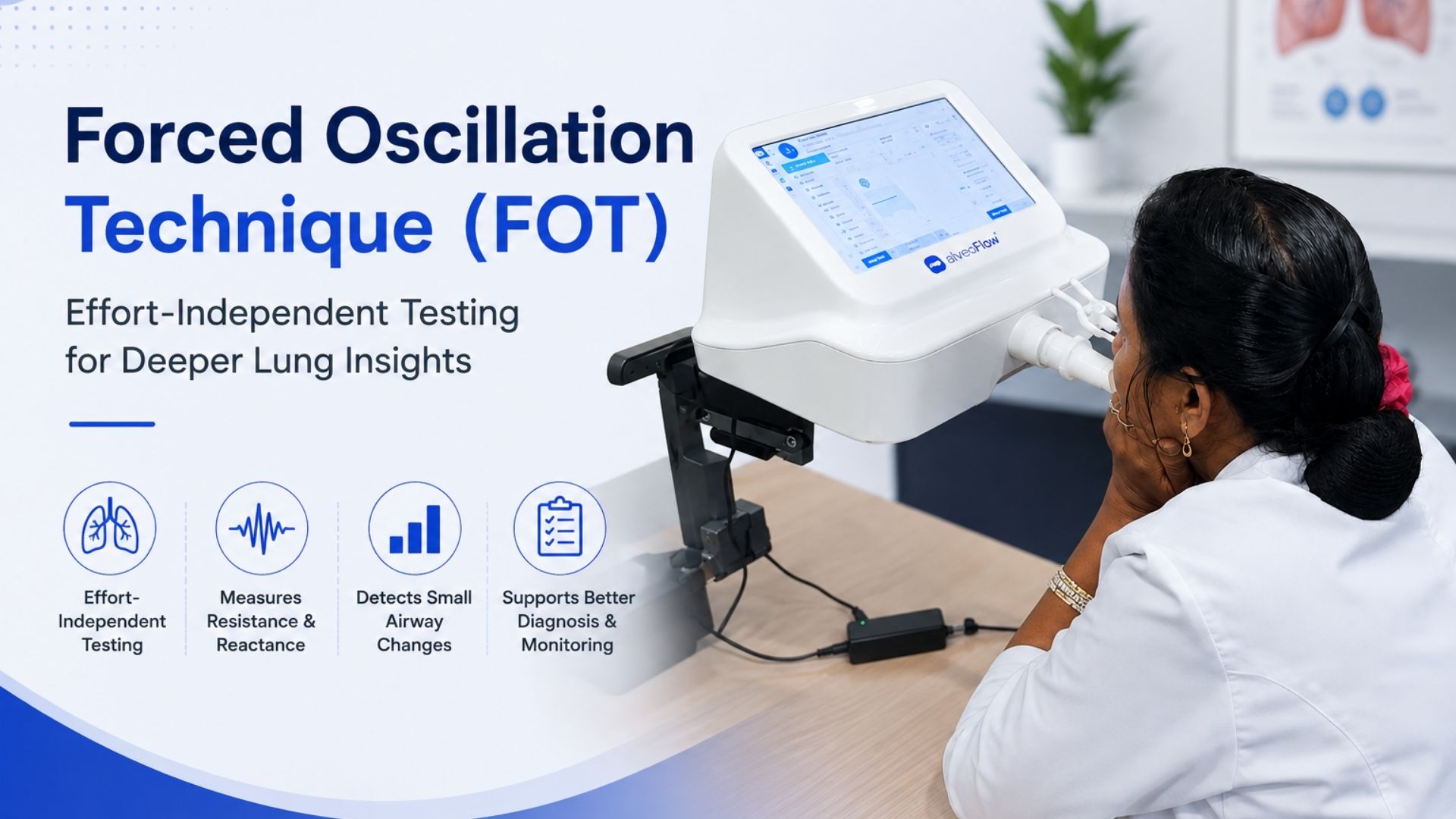
What if a lung function test could tell you more about how the respiratory system responds without asking you to take a deep breath and forcefully blow out? That is the idea behind Forced Oscillation Technique (FOT).
Instead of relying on repeated forced breathing, it measures how the respiratory system responds to small pressure changes while the patient breathes normally. But what exactly happens during the test? What do measurements such as resistance, reactance, and respiratory impedance actually tell us?
If you are looking for answers to what Forced Oscillation Technique is, this guide explains the technique in simple terms. Here we discuss how the measurement works, what it measures, and how it can provide information about the small airways.
What Is Forced Oscillation Technique?
Forced Oscillation Technique (FOT) is a non-invasive lung function testing method that assesses how the respiratory system responds to small, controlled pressure changes during normal breathing. It provides information about respiratory mechanics without requiring a forceful breathing manoeuvre.
The technique uses an oscillometry device connected to a mouthpiece. As the patient breathes normally, the device introduces small pressure oscillations, meaning gentle and controlled changes in pressure, into the respiratory system.
The device then measures the airflow and pressure response produced by these changes. It uses this pressure-flow relationship to calculate respiratory impedance, which describes how the respiratory system responds to the applied signal. Respiratory impedance has two main components:
| Measurement | What It Describes |
| Resistance | How much the respiratory system opposes airflow |
| Reactance | How the elastic and inertive properties of the respiratory system respond to the pressure signal |
Together, these measurements allow FOT to assess respiratory mechanics during normal tidal breathing. This means the patient does not need to take a maximal breath or perform a forced expiration, making the technique largely independent of breathing effort.
How Does a Forced Oscillation Technique Test Work?
A forced oscillation technique test measures respiratory mechanics by applying small pressure oscillations while the patient breathes normally through a mouthpiece. The device records the resulting pressure and airflow response and uses these measurements to calculate respiratory impedance, resistance, and reactance.
The process of a FOT test is actually fairly simple:
Step 1: The patient sits comfortably
The patient places the mouthpiece in their mouth and starts breathing normally. They simply continue their usual breathing while the device takes the measurement.
Step 2: The patient breathes normally
Once the test begins, the patient continues tidal breathing. This simply means the patient performs normal, relaxed breathing.
Step 3: The device introduces small pressure changes
The oscillometry device generates forced oscillations, which are small and controlled changes in pressure. These signals are introduced through the mouthpiece while the patient continues breathing normally.
Step 4: The device captures the respiratory response
The device measures the resulting airflow and pressure response as these pressure changes move through the respiratory system. This shows how the airways and other parts of the respiratory system respond to the applied signal.
Step 5: The system analyses the measurements
The device then uses the pressure-flow relationship to calculate respiratory impedance, including resistance and reactance. Measurements can be taken across different frequencies to provide further information about respiratory mechanics.
This entire process allows the FOT lung function test to assess respiratory mechanics without requiring the patient to perform repeated Forced Expiration Technique.
What Does FOT Measure?
Forced oscillometry technique measures respiratory impedance. It tells us how the respiratory system responds when the device applies small pressure changes during normal breathing. This response is described through two main components known as resistance and reactance.
Resistance tells us how much the respiratory system opposes airflow. Reactance tells us how the elastic and inertial properties of the respiratory system respond to the applied pressure signal. FOT then uses different measurements to describe these responses at different frequencies. This is where parameters such as R5, R20, R5–R20, X5, AX, and Fres become useful.
| Parameter | What It Measures | What It May Tell Us |
| R5 | Resistance at 5 Hz | Overall respiratory resistance |
| R20 | Resistance at 20 Hz | Resistance influenced more strongly by the larger airways |
| R5–R20 | Difference between R5 and R20 | May indicate greater peripheral airway involvement |
| X5 | Reactance at 5 Hz | Elastic and inertive properties of the respiratory system |
| AX | Area of reactance | Changes in low-frequency reactance |
| Fres | Resonant frequency | The frequency at which reactance reaches zero |
Together, these measurements show how the respiratory system responds to the oscillatory signal. Looking at the pattern across these parameters can provide useful information about airway resistance, respiratory mechanics, and possible small airway dysfunction.
How Can FOT Provide Information About the Small Airways?
FOT can provide information about the small airways by examining how respiratory resistance and reactance change at different frequencies.
During the measurement, the oscillometry device applies pressure signals at different frequencies while the patient continues to breathe normally. The respiratory system responds differently to these frequencies, and that difference gives clinicians more information about where changes in respiratory mechanics may be occurring.
Lower-frequency measurements, for instance, can provide greater sensitivity to the peripheral airways, including the smaller airways. This is why measurements such as R5, R20 and R5–R20 can be useful when assessing peripheral airway involvement.
- R5 measures respiratory resistance at 5 Hz and reflects resistance across the respiratory system.
- R20 measures resistance at 20 Hz and is influenced more by the larger airways.
- The difference between the two, R5–R20, can therefore provide information about changes that may involve the peripheral airways.
X5 and AX provide another part of this information through respiratory reactance. Changes in these measurements can reflect altered mechanical behaviour in the peripheral respiratory system and may be associated with small airway dysfunction.
The forced oscillometry technique does not directly visualise the small airways or measure their diameter. Instead, it uses the respiratory system's response to different pressure signals to provide physiological information about possible peripheral airway involvement.
Why Can FOT Be Useful When Spirometry Is Difficult?
Imagine a young child who needs lung function testing but cannot quite manage the instructions for a forceful breath. They may understand what the clinician is asking, yet producing a strong, sustained expiration can still be difficult. The same challenge can arise in an older adult or someone who is already struggling to breathe.
This is where the difference in testing approach becomes important. Spirometry depends on a patient performing a controlled, forceful breathing manoeuvre. If the patient cannot perform that manoeuvre properly, the test may be difficult to complete or may produce results that need careful interpretation.
FOT takes a different approach. The patient can continue breathing normally while the device applies small pressure changes and measures the respiratory response. There is no need for a maximal breath or prolonged forced expiration.
That makes Forced Oscillation Technique more useful when patient effort is a practical limitation. It can support paediatric lung function testing, including in young and preschool children. It can also support assessment in older adults and other patients who have difficulty with forced breathing.
The forced oscillometry technique can also provide information related to airway obstruction, bronchial hyperresponsiveness and bronchodilator response. It therefore has a role beyond simply making testing easier. It gives clinicians another way to assess respiratory mechanics when conventional forced breathing manoeuvres are difficult to perform.
Who Can Benefit From FOT Testing?
FOT can be particularly useful when a patient finds forced breathing manoeuvres difficult or when clinicians need additional information about respiratory mechanics. Since the test is performed during normal breathing, it can be considered for:
- Young and preschool children
- Patients who cannot perform reliable spirometry
- Older adults who struggle with forced breathing manoeuvres
- Patients who require minimal patient cooperation
- Patients being assessed for asthma, COPD and other respiratory conditions
- Clinical and research settings requiring detailed assessment of respiratory mechanics
Note that the forced oscillometry technique does not replace spirometry in every situation. It can instead provide a useful complementary approach to patients as mentioned above.
Conclusion
So, what is Forced Oscillation Technique in practical terms? It is a way to measure respiratory mechanics while a patient breathes normally. Small pressure oscillations create a measurable respiratory response, allowing the system to calculate resistance, reactance, and impedance with minimal patient effort.
This makes FOT especially useful when forced breathing is difficult. It can provide additional information about airway resistance and peripheral airway function, while making respiratory assessment more comfortable and accessible for patients. FOT expands what clinicians can measure and how they can assess patients.
That’s exactly what we aim to help clinics achieve at alveofit with alveoflow. Our effort-independent FOT solution is designed to give clinicians access to respiratory mechanics measurements without relying on repeated forced breathing manoeuvres.
Explore our respiratory testing solutions and buy them online today.
FAQs
Is Forced Oscillation Technique the same as spirometry?
No, FOT measures respiratory mechanics during normal breathing, while spirometry relies on forced breathing manoeuvres.
Can Forced Oscillation Technique be used for children?
Yes, FOT can be useful for young and preschool children who may struggle to perform the forced breathing required for reliable spirometry.
What do R5 and R20 mean in FOT?
R5 measures respiratory resistance at 5 Hz, while R20 measures resistance at 20 Hz. Their difference, R5–R20, can provide information about possible peripheral airway involvement.